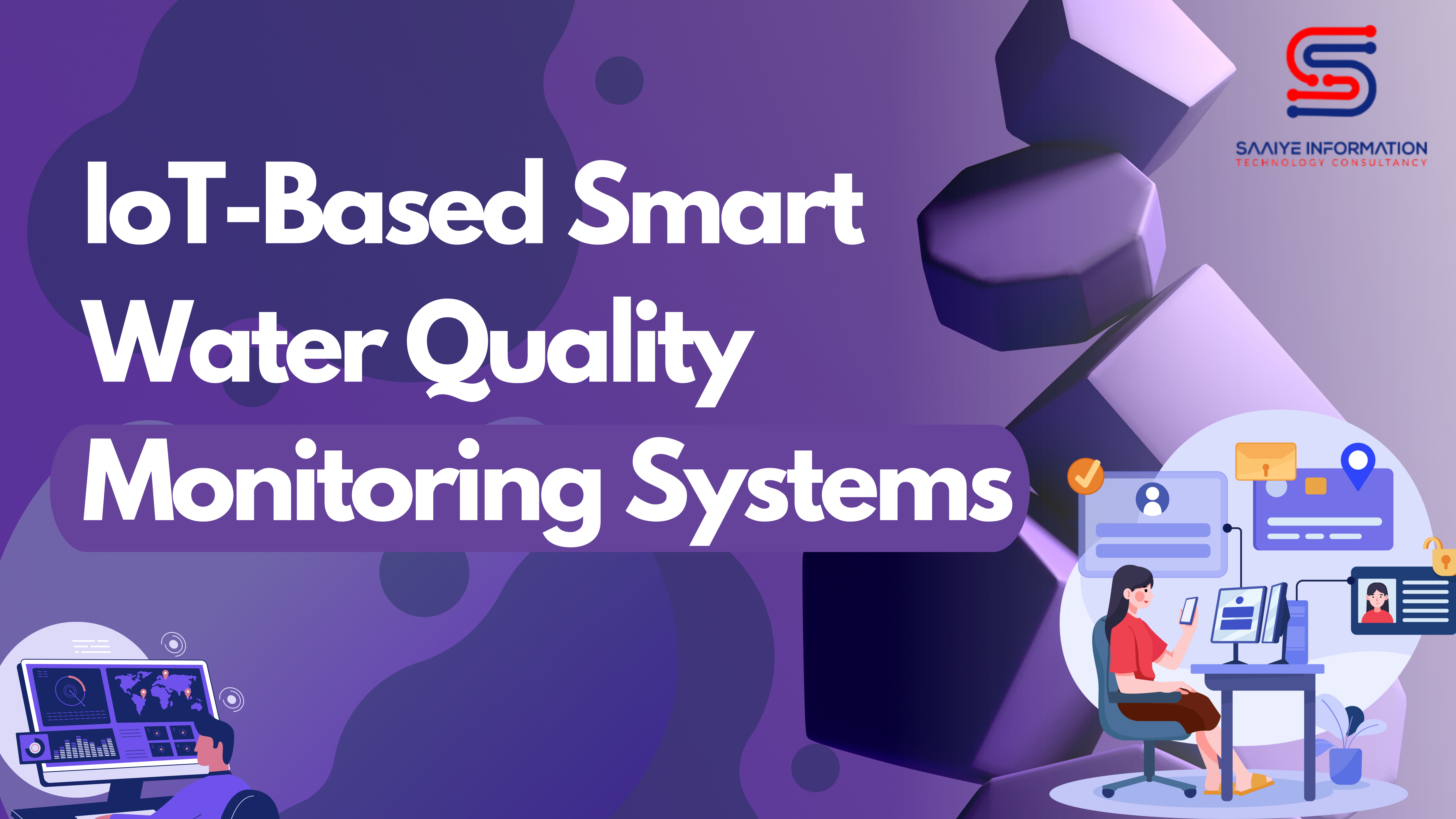
Water Quality Monitoring System is crucial in the provision of clean, safe and sustainable water in industries, agriculture and the community. As the IoT technology is integrated, the conventional way of water monitoring has changed to a wiser, data-oriented process. Saaiye Information Technology Consultancy is the best firm to offer innovative IoT-based systems which can provide real-time water analysis, predictive analytics and automated solutions to manage industries and municipalities.
Understanding Smart Water Quality Monitoring Systems
A smart water monitoring system is based on an IoT sensor that measured the parameters of pH, turbidity, dissolved oxygen, and temperature among others in real-time. The sensors also send the data to the centralized platform via IoT gateways, allowing analysis and tracking at a distance. This automation reduces errors in the hands of people and there is immediate feedback of water quality so that it becomes compliant with the environmental and industrial requirements.
Industrial IoT’s Role in Water-Intensive Industries
Industrial IoT solutions have been revolutionary in the water-intensive industries that include chemicals, energy and food processing. Industries can use wet water consumption, leakages and quality control by linking sensors and smart meters to a central cloud platform to ensure that the quality standards remain uniform. This real time information enables making predictions on its maintenance, cost reduction and regulatory adherence, which are essential in operations that are sustainability oriented.
Smart Irrigation in Agriculture Using IoT
Smart irrigation systems using IoTs assist farmers in maximizing the use of water resources by integrating soil moisture sensors, weather data, and automation. These systems make sure that crops get the appropriate level of water without wastage improving the yield and saving resources. Cloud dashboards will allow farmers to monitor the conditions of the soil and the water level in the fields, which will enable them to irrigate their lands in time. IoT tank-level monitoring will be able to implement efficient water availability even in remote agricultural areas.
Advantages:
- Promotes efficient water conservation and targeted irrigation.
- Enables remote control through smartphones and connected devices.
- Improves crop productivity and reduces operational costs.
Disadvantages:
- Initial infrastructure cost can be high.
- Dependent on reliable internet connectivity and data accuracy.
Smart Urban Water Management with IoT
Cities are increasingly moving towards smart water meters and water surveillance systems. The IoT devices offered can look into proper data on water consumption, detect leakages, and provide equitable water billing to consumers. Centralized monitoring dashboard will help the authorities analyze consumption patterns and distribute water in cities more effectively.
Advantages:
- Reduces water wastage through instant leak detection.
- Enhances operational efficiency and billing transparency.
- Supports water conservation initiatives at community levels.
Disadvantages:
- Requires substantial initial investment.
- May raise concerns about data privacy and network reliability.
Industrial IoT for Smart Water Solutions
Industries require high-quality water for manufacturing, cooling, and processing. IoT-based water management solutions by Saaiye Information Technology Consultancy enable industries to maintain precise control over water usage, quality, and system performance. Smart sensors continuously monitor the parameters, allowing companies to minimize waste, meet environmental standards, and optimize resources.
Advantages:
- Predictive maintenance reduces downtime and repair costs.
- Real-time monitoring ensures compliance with quality norms.
- Data-driven insights improve efficiency and cost-effectiveness.
Disadvantages:
- Complex integration with existing systems.
- Vulnerability to data security risks if not properly managed.
Challenges in Implementing IoT-Based Water Systems
Despite the numerous advantages, certain challenges remain in deploying IoT-driven monitoring systems:
- High Initial Costs: Setting up IoT infrastructure, sensors, and cloud integration requires significant investment.
- Connectivity Issues: Remote or rural areas often face unstable internet connections affecting real-time data flow.
- Data Overload: Managing and analyzing large volumes of sensor data requires advanced analytics tools and expertise.
- Cybersecurity Concerns: Connected systems must be protected from hacking or data breaches through robust encryption protocols.
Traditional vs Smart IoT Monitoring
| Criteria | Traditional Systems | IoT-Based Systems |
| Data Collection | Manual sampling | Automated real-time data |
| Accessibility | On-site only | Remote cloud access |
| Response Time | Slow and delayed | Instant alerts and action |
| Scalability | Labor-intensive | Easily scalable |
| Cost Efficiency | Higher long-term cost | Optimized operational expenses |
The Future of Smart Water Monitoring
The future of water management is in the application of IoT, combined with Artificial Intelligence (AI) and Machine Learning (ML). These technologies will also allow smarter predictions, self-correcting systems and advanced analytics in managing water quality. IoT solutions will be more affordable and connectable with strong connectivity in both urban and rural areas, and it will make it a widespread implementation.
With the advanced technology, the industries can fully automate the process of water usage, and zero waste will be produced with the sustainable production. To improve reliability and durability, IoT systems will be improved with such features as self-diagnostics, automatic calibration, and energy-saving designs.
Conclusion
A smart water management is not only an option in the current age of technologies but also a must. IoT Water Quality Monitoring System by Saaiye Information Technology Consultancy enables industries, farmers, and local governments to be efficient and reduce water consumption and usage to a sustainable level. These systems save money, improve efficiency and most importantly, preserve valuable water resources because they are implemented with real-time analytics, predictive maintenance and automated control. With the further development of IoT, smart water monitoring will be one of the most important factors when guaranteeing clean, safe, and sustainable water to the new generation.