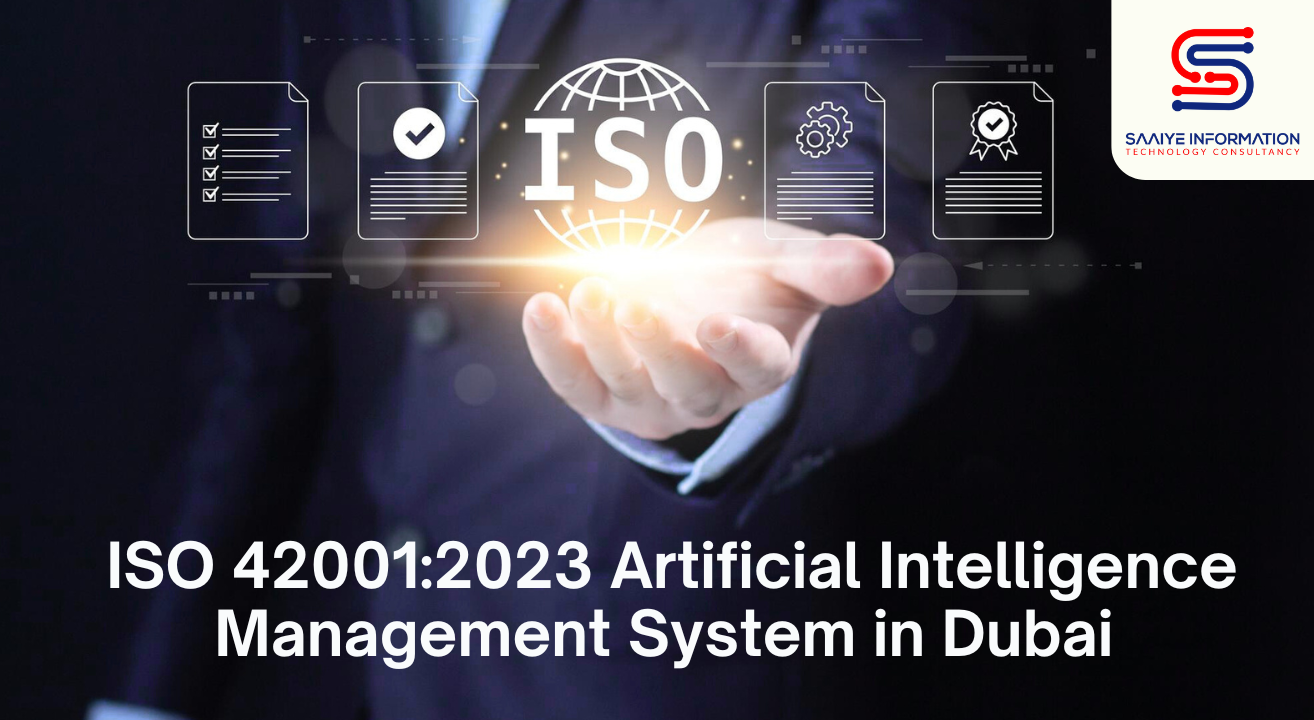
The ISO 42001:2023 AIMS Consultancy in Dubai is gaining more and more significance as organizations move towards the faster uptake of artificial intelligence as the risk of ethics, transparency, and risk mounts. In Saaiye Information Technology Consultancy, we assist companies in finding their way through the new era of AI governance by balancing the areas of innovation and responsibility, as well as, compliance.
AI is not experimental anymore, it is being used in the decision-making process of many industrial fields: healthcare, finance, retail, logistics, and government services. AI provides efficiency and intelligence at predictive analytics to automated decision engines. There is, however, accountability that is associated with this power. Algorithms bias, lack of transparency, data privacy threats, and uncontrollable model behavior has caused companies to consider structured control mechanisms instead of informal control.
This is where the ISO/IEC 42001:2023 standard qualifies as the first Artificial Intelligence Management System (AIMS) of the world. The standard, published in 2023, offers an official, auditable structure through which organizations can deal with AI in a responsible manner during its lifecycle.
What Is ISO/IEC 42001:2023?
The ISO/IEC 42001 lays out the specifications on how an Artificial Intelligence Management System should be set up, implemented, maintained and continuously improved. It is applicable to any organization that develops, deploys, or uses AI systems of any size or industry. Regardless of the application of AI in customer profiling, credit scoring, diagnostics, or automation, the standard will make sure that these systems are ethical, secure, and reliable.
In contrast to the conventional IT standards, ISO 42001 is specifically aimed at the challenges related to AI. It discusses the problem of opaque decision-making, the changing machine learning models, the possibility of bias, and the necessity of constant monitoring. The standard also conforms to the other ISO structures of management systems making it easy to integrate with other structures, such as ISO 27001 or ISO 9001.
Why ISO 42001 Was Developed
The adoption of AI has been higher than governance in most organizations. On the one hand, automation and predictive services are beneficial to businesses, whereas on the other hand, there are multiple high-profile failures of biased algorithms, unsafe AI behavior, and privacy invasion that shook the trust of the population. The regulation of regulators around the world is tightening, with new AI legislations and ethical standards.
The ISO 42001 has been created to offer a standardized and universal system that can be used to assist the entity to manage AI risks on a proactive basis rather than responding to cases. It makes AI systems transparent, accountable, and in line with human values as well as enhancing innovation.
Core Principles of ISO 42001
The standard is built on foundational principles that shape responsible AI governance:
- Ethical AI Use: AI systems must respect human rights, avoid discrimination, and support socially beneficial outcomes.
- Transparency: Organizations should document how AI systems work, what data they use, and how decisions are made.
- Accountability: Clear ownership and responsibility for AI systems must be defined, ensuring human oversight remains central.
- Security and Privacy: Strong controls must protect AI models and data from breaches, misuse, and unauthorized access.
- Continuous Improvement: AI systems require ongoing monitoring, updates, and reviews as risks and technologies evolve.
- Fairness: Regular bias assessments and fairness testing help prevent discriminatory outcomes.
Structure and Key Requirements of ISO 42001
The ISO 42001 is structured in 10 clauses in line with other standards of the management systems ISO. These provisions encompass organizational environment, leadership dedication, risk-based planning, controls in operations, performance assessment and continuous enhancement.
The standard also comprises of more AI-specific controls that are under defined objectives. These controls cover data governance, model validation, impact assessment, change management, incident management and handling. The standard contains annexes that give guidance on implementation, examples of AI risks, and industry considerations.
How Organizations Can Implement ISO 42001
The implementation of ISO 42001 is a process that cannot be done in one instance. The initial activity in organizations is to find out all AI systems deployed and estimate associated risks. Governance strategy is subsequently determined stating policies, roles, and responsibilities.
Then, the organizations introduce controls throughout the AI lifecycle, which encompasses design and development, deployment, and monitoring. The use of training and awareness will guarantee the employees are aware of ethical AI practices. Monitoring, audits and management reviews are part of the continuous checks to ensure the effectiveness and improvement.
Benefits of ISO 42001 Implementation
Implementing ISO 42001 in organization comes with a number of benefits. It enhances a sense of trust among the customers, regulators, and partners because it exhibits responsible AI practices. Ethical and risk considerations become part of every day operations making it easier to comply with the law and regulations.
The standard also enhances uniformity of operations, less reputational risk and innovation within a regulated environment. Through AI governance standardization, organizations will be able to scale AI initiatives comfortably without undermining safety or equity.
Who Should Consider ISO 42001?
The ISO 42001 can be applied to the enterprises that utilize AI in critical decision-making, AI product designers, regulated industries, government departments, research organizations, and enterprises that expand AI across the regions. It is adaptable to absorb new AI adopters and established AI-oriented organizations.
Conclusion
By adopting an AI management solution that is compatible with ISO 42001, organizations can strike the right balance between technology and responsibility towards the community. Under the tutelage of Saaiye Information Technology Consultancy, the businesses are able to develop sound AI governance that fosters trust, compliance, and sustainable innovation. Through embracing global best practices in the present day, organizations are set to have a future where AI is potent and reliable.