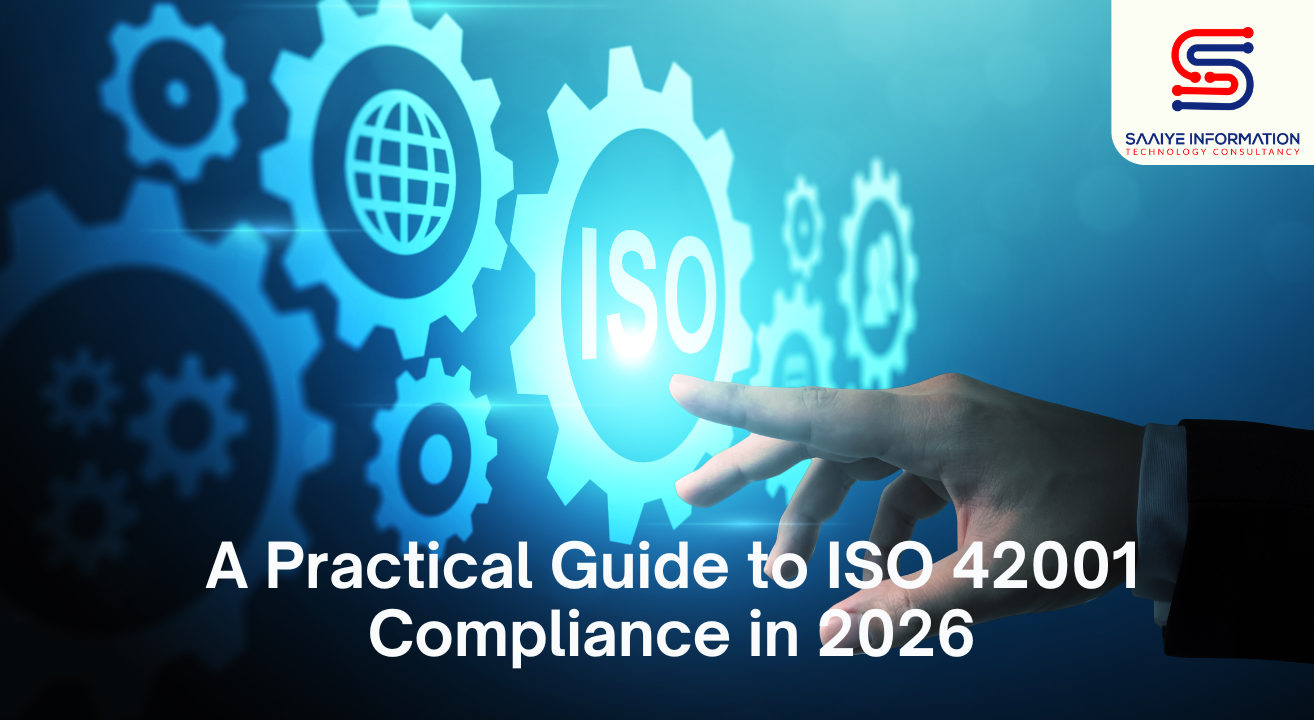
The scale of artificial intelligence implementation in organizations makes ISO 42000 Consultancy in UAE more significant. At Saaiye Information Technology Consultancy, we assist the business to realize that AI is not merely a technology privilege any more, it is a governance role. With AI systems becoming a factor in hiring, healthcare, finance, customer profiling and operational decisions, organizations are likely to demonstrate that the systems are safe, just, and responsible.
By 2026, firms with no systematic AI governance can be governed, lose clients, and its reputation could be damaged. The ISO 42001 provides a simple and effective model to coordinate these risks and show the responsible use of AI.
What Is ISO 42001?
The ISO 42001 is the initial international standard devoted to the Artificial Intelligence Management Systems (AIMS) only. The standard does not concentrate on the particular algorithms or technical code, but instills the principles of governance, risk management, accountability, and continuous improvement across the AI lifecycle.
ISO 42001 helps organizations answer critical questions such as:
• Are decisions that are made by AI transparent and explainable?
• Have threats such as bias or misuse associated with AI been detected?
• Lack of accountability in the event of failure in AI systems?
• Do AI systems support organizational values and legal expectations?
The standard is also compatible with the other management systems in place like the ISO 27001 (Information Security) and 9001 (Quality Management), hence it will be easier to implement without interruption by organizations.
Who Needs ISO 42001 Compliance?
The ISO 42001 is applicable to any entity that develops, implements or uses AI irrespective of industry or the size of the organization. It is not required to be an AI software company to be within its range.
Organizations that should consider ISO 42001 include:
- AI developers and solution providers
- Companies using AI for customer profiling or decision-making
- Healthcare, finance, and insurance firms using AI analytics
- Government agencies using AI for public services
- Businesses relying on third-party or cloud-based AI tools
Even when AI systems are outsourced, the responsibility for governance and risk management remains with the organization using them.
Core Requirements of ISO 42001
ISO 42001 establishes structured controls to ensure responsible AI usage across the entire lifecycle.
Leadership and AI Governance
Top management must actively support AI governance by defining policies, assigning responsibilities, and aligning AI use with business objectives and ethical principles.
AI Risk and Impact Assessment
Organizations must identify and assess risks such as bias, privacy violations, model failure, or misuse. These risks must be documented, reviewed, and updated regularly.
AI Lifecycle Management
AI systems should be managed from design and development through deployment, monitoring, modification, and retirement. Changes must follow controlled processes.
Data and Model Management
The standard emphasizes data quality, traceability, fairness, and transparency. Organizations must understand where data originates and how models are trained and validated.
Monitoring and Continuous Improvement
AI systems must be continuously monitored for errors, performance issues, and unintended outcomes, with corrective actions taken when required.
Step-by-Step Approach to ISO 42001 Compliance in 2026
Phase 1: Defining the Scope
Scoping identifies those AI systems, processes, and business units that are part of the AIMS. Defined scope eliminates lapses and makes compliance activities realistic.
Phase 2: Gap Assessment
This step is the comparison of the present AI practices with ISO 42001 requirements. It assists in determining controls and documentation gaps as well as high-risk areas.
Phase 3: Implementing Controls
To address AI, organizations formulate governance policies, assign AI ownership, handle risks, impose data and model controls and train employees on AI obligations. It is at this stage that AI governance will be integrated into reality.
Phase 4: Internal Audit
Audits within the company ensure that the AIMS is effective and compliant. Results are used to rectify the weaknesses prior to certification audit.
Phase 5: Certification Readiness
Last reviews and meetings with management, non-conformities closure, and evidence preparation make sure that the organization is capable of certification by an accredited entity.
Common Challenges and How to Overcome Them
Some of the challenges encountered in organizations include lack of awareness regarding the risks of AI, inadequate visibility of AI use, poor management of third-party tools, and lack of willingness to comply with governance processes. They can be resolved by means of training employees, centralized AI inventories, supplier risk assessment, and good leadership.
One should not consider the ISO 42001 as a checklist, but as a strategic framework, which may assist organizations in implementing AI in a responsible way and creating trust and sustainable development in the long term.
Why ISO 42001 Matters Now
AI risks are increasing, and regulations are rapidly evolving worldwide. ISO 42001 helps organizations:
- Build trust with customers and regulators
- Reduce AI-related operational and legal risks
- Ensure AI decisions are explainable and accountable
- Prepare for upcoming global AI regulations
- Gain a competitive advantage through responsible AI practices
Conclusion
The ISO 42001 offers a viable and futuristic AI governance. Early actors will be able to mitigate risk, improve credibility, and achieve the highest possible value of AI investments. In the globalized world, the tightening of the rules has made today the preparation of tomorrow.
In Saaiye Information Technology Consultancy, we assist the organization in designing, implementing, and certifying the high-quality AI management systems that meet the ISO 42001 requirements. Professional development from gap assessments to certification readiness, our professionals will go through each step with clear and confident explanation. Collaborate with us in establishing an accountable, compliant and trusted AI governance system by 2026 and beyond.